Observing Run Report – April 14-17, 2003
Date: April 23, 2003
From: M. Colavita, P. Wizinowich
Summary
The run was Mon. Apr. 14 (1st half), Tues-Wed. Apr. 15-16 (full), and Thurs. Apr. 17 (Caltech, full).
The run went fairly well. There were scattered clouds all four nights, leading to small amount of lost time during the run, and a significant efficiency impact on the last night. All planned interferometer engineering tests data calibration tests were completed. A total of 10 science sources were observed, and fringes were detected on 6 of them; all but one source was new for KI. The detected sources consisted of 1 main sequence binary, 3 young stellar objects (2 resolved, 1 not resolved) and 2 young stellar binaries. For the undetected sources, 1 was too faint for AO and the other 3 are likely to be over-resolved by the KI baseline, as fringes were not found despite searching. This brings the total list of KI detected sources to 16. The April run was also the first post-handover run, with CARA conducting all setup and science observations.
General priorities that were identified for this run
· Science observing (~1.5 nights); conducted by CARA
· All pre-run setup conducted by CARA
· Full-up test with sequencer conducted by CARA
· Priority punchlist items and calibration tests (~1.0 nights)
These priorities were achieved.
See http://keck-lib.jpl.nasa.gov/Get/File-3482 for the April punchlist with final status.
Future scheduled runs
· Sun May 18 (½), Mon May 19 (full), Tue May 20 (full), Wed May 21 (full, CIT)
· June off
· Mon Jul 14 (½), Tue Jul 15 (full), Wed Jul 16 (full), Thu Jul 17 (full)
See http://keck-lib.jpl.nasa.gov/Get/File-3594 for the new May punchlist.
Engineering test summary
See http://keck-lib.jpl.nasa.gov/Get/File-3593 for the detailed engineering log. The nightlogs and engineering plan are attached below.
· N0 Fringe tracker full-up nightly test – conducted nightly.
· N7 K2 aberration contingency test plan – conducted at beginning of second night when aberration was seen.
· N9 29 Hz filter optimization – completed. The filter worked pretty much as expected, and was effective at eliminating the 29 Hz vibration seen on K1. We ended up running with a slightly lower gain than used with internal tests, due to some beating we were seeing on the residuals (likely due to some other vibrations near 29 Hz that were not being eliminated). We used the 29 Hz filter for the remainder of the run, except for when we slowed KAT to 20 Hz.
· N10 K1 Facility Glycol blower on/off test – completed (initial look at data suggests is that blower state does not affect K1 secondary vibration).
· N11 Bright-star / faint-star / laser block filter phase and amplitude test – completed. We obtained several long tracks on the bright star, but did not do the faint star or laser-block filter tests. However, we did not have problems with laser scatter, even at slow frame rates.
· N12 AO stimulus test – completed; need to analyze data carefully. On first night the test was done, we observed lower 1/f with stimulus, contrary to previous tests.
· Other engineering data
· AO telemetry and diagnostics at different gain and frame rate settings to determine if we are amplifying the 29 Hz tip/tilt term.
· AO atmospheric characterization data with our new tool.
· Calibration
tests
Calibration tests on a PTI binary, stars of different magnitudes, and stars
of different colors, were also completed.
Uptime monitoring
 Accumulated
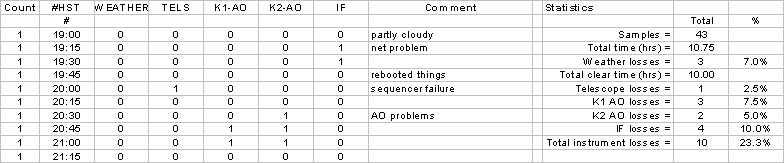
over the run, the downtime for the interferometer (including time searching
for fringes on objects that should have been unresolved) was 15%; for the
telescopes and AO: 10%. Details are in the (embedded) spreadsheet, which
includes worksheets for each night, and also in the engineering log, below.
Accumulated
over the run, the downtime for the interferometer (including time searching
for fringes on objects that should have been unresolved) was 15%; for the
telescopes and AO: 10%. Details are in the (embedded) spreadsheet, which
includes worksheets for each night, and also in the engineering log, below.
Achieved scans per hour were TBD.
Phasing summary
The two telescopes were last phased 2 months ago during the Feb. interferometer run. Test 962 option A, full up fine screen (FSx1(2);FSx8) and phasing (CPH30), was therefore run on both telescopes at the start of the April run (K1 on Sunday night, and K2 on the first IF night). We do not have information about how well stacking and phasing worked since this would have taken another iteration. We do have information however about the starting conditions. On K1 the primary mirror stacking rms was 521 nm and the rms piston was 30 nm. On K2 the primary rms was not recorded but the rms piston was 191 nm. Running fine screen on K1 may therefore have been adequate, but K2 needed to be phased.
Peter’s spreadsheet is
here: 
Other notes
- The k1aoserver upgrade seems to be working well. Automation units are more reliable, taking atmospheric characterization data on k1 is several times faster than on k2.
- The k1 wfc upgrade is more reliable. PRC and backgrounds loading reliably. Data bursting on data from wfc to sc needs investigation.
- Multiple tests of the autoacquisition tool were conducted. Interprocess communication problems were a significant problem.
- IF sequencer hung when using the telescope sequencer.