Continuous focusing (CF) using secondary piston
(based on the method proposed by T.Mast and J.Nelson, 2003)
Test plan for Sep 18, 03
Purpose:
- To determine secondary mirror motions necessary to get detectable image size variations
- To determine detectable image size variation at different air masses (different elevations) and different exposure times
- To monitor possible temperature increase at the secondary mirror drivers area
The SSC camera will be used as a detector to acquire the images during the test. As at this point there is no synchronization between the SSC guider mode and secondary continuous focus motions, the telescope guiding will be conducted manually with reference to the star image on the SSC detector.
The continuous focusing script will issue commands for sequential mirror motions and image acquisition.
A secondary mirror motion cycle:
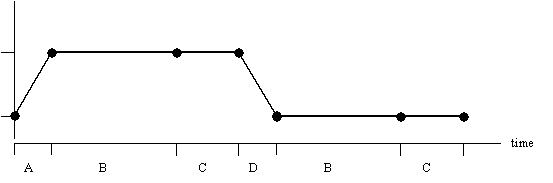 |
A - secondary mirror move to a prescribed position (around 0.5 sec)
B - software/hardware communication time (around 10 sec)
C - exposure time (depends on a star magnitude, 15 sec for 11-12m, 0.5 sec for 5-6m)
D - secondary mirror move back (0.5 sec)
The total time for one cycle may vary from 22 sec for 5-6m star to 51 sec for 11-12m star.
We can try to do the exposure time (C) during the communication time (B) reducing the total cycle time.
Each cycle will produce a pair of images for real time secondary focus calculation.
The test will be conducted right after PCS optical tests (standard tests after a regular segment exchange). It will assure the “best” primary mirror figure and secondary mirror positioning.
Schedule:
- Switch the tertiary mirror to the SSC position. Select a star v=11, el = ~80°. Run Autofoc on SSC. Note that currently telfoc for the SSC is PCS + 0.85 (on K1) (it can be rechecked using the Autofoc data and corrected if necessary).
(note: the test will start with a star close to zenith)
- Pick a bright star (v=5-6) at el = ~80°. This will allow starting with short exposures (a 0.5 sec exposure).
- Start the secondary mirror CF run #1:
o +/- 0.025 mm, 10 cycles (20 moves), one move every 11 sec
o acquire the image from SSC after each movement. Use 1x1 binning. (note: the proposed number of moves is 10. We will do 20 moves to evaluate an optimal number for focus calculation as the image change supposed to be very small)
o total time for run #1: 11sec x 20 = + 3 min 40 sec
- Start the secondary mirror CF run #2
o +/- 0.05mm, 5 cycles (10 moves), one move every 11 sec
o acquire the image from SSC after each movement. Use 1x1 binning.
o total time for the CF run #2 is 11 sec x 10 = 1 min 50 sec
- Pick a star with v= 8-9 at el = ~80°. This will require longer exposure (around 5 sec).
- Start the secondary mirror CF run #3:
o +/- 0.025 mm, 5 cycles (10 moves), one move every 16 sec
o acquire the image from SSC after each movement. Use 1x1 binning.
o total time for run #3: 16sec x 10 = 2 min 40 sec
- Start the secondary mirror CF run #4
o +/- 0.05mm, 5 cycles (10 moves), one move every 16 sec
o acquire the image from SSC after each movement. Use 1x1 binning.
o total time for the CF run #4 is 16 sec x 10 = 2 min 40 sec
- Now we will introduce an error in the secondary despace. Apply the secondary mirror piston, e= + 0.1 mm
- Do steps 7 (run #4) (+2 min 40 sec)
- Apply the secondary mirror piston, e = - 0.1 mm
- Do steps 7 (run #4) (2 min 40 sec)
- Move the secondary back to the nominal position.
- Select a star v = 8-9, el = 40°-42° (note: the test will proceed with a star closer to horizontal telescope position. The purpose is to test the method at different secondary mirror orientation and at a bigger airmass (1.5x))
- Do steps 7 (run #4). (2 min 40 sec)
- Apply the secondary mirror piston, e = - 0.1 mm
- Do steps 7 (run #4) (2 min 40 sec)
- Move the secondary back to the nominal position.
- Select a star v = 11-12, el = 40°-42°. This will require around 10 sec exposure.
- Start the secondary mirror CF run #5
o +/- 0.05mm, 5 cycles (10 moves), one move every 21 sec
o acquire the image from SSC after each movement. Use 1x1 binning.
o total time for the CF run #5 is 21 sec x 10 = 3 min 30 sec
- Apply the secondary mirror piston, e = - 0.1 mm
- Do steps 18 (run #5) (3 min 30 sec)
- By this time the secondary mirror has been in a continuous movement state for around 35 min. Now we will try to catch any local seeing changes due to heat generated by the mirror motors.
- Select a star v = 11-12, el = 40°-42°. Take the MIRA images using the SSC. We expect that airflow (if any) will degrade the images from the segments located at the upper part of the primary mirror.
- Do the MIRA test the second time. Offset the segment #27 using PMFM additional sensor offset of 200 nm. It will allow checking the SSC camera orientation.
- If time permits, we can try fainter stars or do the test with telescope closer to horizon.
Notes:
- The test needs to be done at good seeing as the image size variations will be very small and hard to detect.
- MIRA images with the SSC (if FM = ± 250 nm, the MIRA image diameter will be ~11 arcsec (the SSC CCD size is 40 x 30 arcsec at F/15). Segment images will be separated by around 2 sec (~20 pixels).